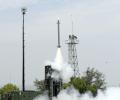
On Friday, April 4, 2025, DRDO and the Indian Army conducted four successful flight-tests of the army version of the Medium-Range Surface-to-Air Missile at the Dr A P J Abdul Kalam island off the coast of Odisha.

India has successfully conducted the maiden salvo launch of the indigenously developed Naval Anti-Ship Missile-Short Range.

The Indian Air Force is set to procure a compact, indigenous unmanned aerial vehicle (UAV) system for its elite Special Forces unit, designed to operate in extreme conditions and high altitudes.

DRDO conducted the maiden flight test of the Long Range Land Attack Cruise Missile from a mobile articulated launcher.

'Agni Prime', the new-generation ballistic missile, was successfully flight-tested from an island off the Odisha coast on Thursday, officials said.

India has approved proposals to procure weapons and military hardware worth Rs 79,000 crore, including Nag missiles, amphibious warfare ships, and electronic intelligence systems, to enhance the military's combat capabilities.

The system performance was also validated through the data captured by a number of radars, telemetry and electro-optical tracking system deployed by ITR, Chandipur.

The Defence Research and Development Organisation on Friday successfully flight-tested a propulsion system that enables a missile to intercept aerial threats at very long range at supersonic speeds.

After being launched, the glide bomb steer towards the target using a highly accurate hybrid navigation scheme, the ministry said.

The largest tranche came in July, in the wake of Operation Sindoor, with the DAC according acceptance of necessity -- or initial approval -- for 10 capital acquisition proposals amounting to approximately 1.05 trillion through indigenous sourcing.

The sophisticated missile, which has a strike range of over 70 km, can fly towards the target at a speed of over 5,555 km per hour.

With new added technologies, including the control system, the missile was test-fired from the Integrated Test Range (ITR) launch pad-III at Chandipur around 10.45 am, said a source at the Defence Research and Development Organisation.

'In today's launch, the 'Pralay' missile was tested for heavier payload and different range to prove the precision and lethality of the weapon'

The vehicle can be used as an aerial target for evaluation of various missile systems.

This MRSAM version is a surface-to-air missile developed jointly by DRDO and Israel Aerospace Industries for use by the Indian Army.

By the time the enemy aircraft is 50 km away, the Akash-NG's computers have calculated the launch trajectory and impact point and launched the missile.

The new variant of the Akash missile (Akash-NG) can strike targets at a distance of around 60 km and fly at a speed of up to Mach 2.5.

The missiles were randomly chosen from the production stock and the entire launch activities were carried out by the specially formed strategic force command and monitored by the scientists of Defence Research and Development Organisation as part of training exercise, a defence scientist said.

Prithvi-2 is capable of carrying 500-1,000 kg of warheads and is powered by liquid propulsion twin engines, the sources said.

The test was carried out by DRDO against a high-speed unmanned aerial target which was successfully intercepted by the missile.

The Prithvi-II missile is capable of carrying 500 kg to 1,000 kg of warheads and is thrusted by liquid propulsion twin engines.
The missile is capable of carrying 500/100 kg of warheads and is powered by liquid propulsion twin engines.

The missile test was carried out from a mobile launcher from launch complex-3 of the Integrated Test Range at about 10 am, defence officials said.

The surface-to-surface Prithvi-II missile is capable of carrying 500 kilogram to 1,000 kg of warheads and is thrusted by liquid propulsion twine engines
India on Thursday successfully test-fired its indigenously developed nuclear capable Prithvi-II surface-to-surface missile with a strike range of 350 km as part of a user trial by the army from a test range at Chandipur in Odisha.
Prithvi-II is capable of carrying 500-1,000 kilogram of warheads and is thrusted by liquid propulsion twin engines.

India on Friday successfully test-fired its indigenously developed nuclear-capable surface-to-surface Prithvi II missile, with a range of 350 km, from a test range near Balasore as part of a user trial by the Army.

The QRSAM system is unique in its ability to operate on the move, searching for and tracking enemy targets; and then fire on a short halt.

Describing the launch of the sophisticated missile as a complete success, ITR Director M V K V Prasad said all the mission parameters were met during the trial. "The missile was randomly chosen from the production stock and the launch activities were carried out by the specially formed Strategic Force Command and monitored by scientists of Defence Research and Development Organisation as part of training exercise," sources said.

The missile is capable of intercepting incoming targets at an altitude of 15 to 25 km was launched against multiple simulated targets of 1,500 km class ballistic missile.

India on Tuesday successfully test-fired for the second time in two days its indigenously developed nuclear-capable Prithvi-II missile, which has a strike range of 350 km, from a test range at Chandipur.
India on Monday successfully test-fired indigenously developed nuclear-capable Prithvi-II missile -- with a strike range of 350 km -- from a test range at Chandipur near Balasore in Odisha.
Inducted into Indian armed forces in 2003, the nine-metre-tall, single-stage liquid-fueled Prithvi II is the first missile to be developed by DRDO under India's prestigious Integrated Guided Missile Development Program.

The HSTDV is an unmanned scramjet demonstration aircraft for hypersonic speed flight, it can cruise at a speed of mach 6 and move up to an altitude of 32.5 km (20 miles) in 20 seconds, the sources said.
Inducted into India's SFC in 2003, Prithvi II, the first missile to be developed by DRDO under India's prestigious Integrated Guided Missile Development Programme is now a proven technology

Indian Armed Forces brought down a number of these drones using kinetic and non-kinetic means.

The flight test fully met all the trial objectives validating complete network centric warfare weapon system, the defence ministry said.

Many new technologies developed indigenously were successfully tested in the Agni-5 trial.
India on Friday successfully test-fired its indigenously-developed nuclear-capable Prithvi-II and Dhanush ballistic missiles in separate trials, boosting the armed forces' operational readiness.

The The Airports Authority of India is likely to procure two counter-drone systems worth Rs 9.9 crore in 2022-23, according to an official document.
 © 2026 Rediff.com - Advertise with us - Disclaimer - Privacy Policy - Sitemap - Feedback - About us - Terms of use - Grievances